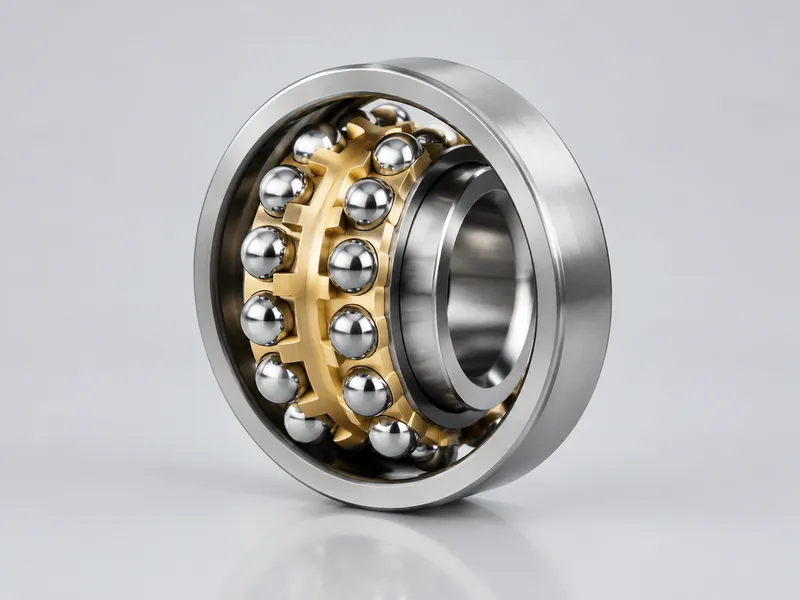
Self-aligning ball bearings compensate for shaft deflection and mounting misalignment of roughly 1.5-3 degrees - for long shafts and frame-mounted assemblies where alignment cannot be held precisely.
Common on agricultural machinery, conveyors and line shafting under light-to-moderate radial load.
Process Overview
Self-aligning ball bearings have a spherical outer raceway that lets the inner ring, balls and cage swivel relative to the outer ring — compensating for shaft deflection and mounting misalignment of roughly 1.5 to 3 degrees.
They suit long shafts, frame-mounted assemblies and applications where alignment cannot be held precisely: agricultural machinery, conveyors, textile equipment and line shafting with light radial loads.
Werkstoffe
Bearing steel (GCr15 / 52100) as standard.
| Material / grade | Standard | Key property | Where it fits |
|---|---|---|---|
| Chrome steel GCr15 / 52100 | GB/T 18254 / ASTM A295 (edition per certificate) | Through-hardening ~1% carbon steel; carries the most load of the three; continuous service to about 120 °C, hardness drops above it (supplier-reported) | The default for standard and OEM positions - motors, pumps, gearboxes - where corrosion and temperature are not the constraint |
| Stainless 440C (on request) | 16-18% chromium martensitic stainless | Chromium oxide passivation film; about 90% of GCr15 wear resistance at HRC 58-62; special heat treatment holds HRC 58 to 260 °C (supplier-reported) | Humid, wet or washdown duty; verify the temperature figure on the certificate rather than assuming it |
| Ceramic hybrid, ceramic balls with steel rings (on request) | - | Balls 3-5x harder than steel and about 50% lighter: lower friction and centrifugal load at speed; brittle under impact or overload | High-speed spindles and marginal-corrosion upgrades; not a substitute for chrome steel where load or shock dominates |
Oberflächen
Standard finishing per product standards; anti-corrosion packaging for export.
| Finish | What it does | Specify it when |
|---|---|---|
| Open (no seal) | Leaves the bearing relubricable in operation, so degraded grease can be purged and L10 life extended in heavy duty | Clean, lubricated environments with maintenance access - the only variant that is not sealed-for-life |
| ZZ metal shields | Blocks coarse ingress without lip contact, so the speed penalty is small (about 10,000 rpm published for small frames, supplier-reported) | Dry, dusty positions at moderate speed where relubrication is impractical |
| 2RS contact seals | Elastomer lip on the inner ring retains grease and blocks ingress, but adds drag: maximum speed drops 20-30%, and on self-aligning types misalignment tolerance falls from about 3 to 1.5 degrees (supplier-reported) | Wet, contaminated or washdown positions - accepting a sealed-for-life replacement schedule, since both 2RS and ZZ are non-relubricable |
Toleranzen
Dimensional and running tolerances to ISO precision classes P0-P6 as standard (P5/P4 on request for applicable types).
| Callout | What it needs | Effect on cost and lead time |
|---|---|---|
| P0 (normal class) | Boundary dimensions and running accuracy only - the class sets no noise, speed or clearance property; below about 3,000 rpm tighter classes are not measurable in service | Standard catalogue price and stock; stated to serve about 90% of industrial applications (supplier-reported) |
| P6 | First step of tighter runout bands, for duties between general machinery and precision spindles | Marginal improvement at a small premium - the cheap end of the step-up curve |
| P5 | Low-vibration, high-speed duty such as machine tool spindles in the 10,000-30,000 rpm band; usually supplied as angular contact, so paired mounting and defined preload come with it | Specialised grinding and matched sets: a significant premium plus mounting expertise on your side |
| P4 | The highest runout accuracy, individually serialized with inspection certificates showing measured values rather than class bands | The expensive end of the curve; quote- and lead-time-critical, confirm before the RFQ goes out |
FAQ
What is your MOQ?
50 pieces per model for standard catalog bearings; custom and OEM bearings are quoted per drawing and volume.
What is the lead time?
5-10 business days for standard samples, 15-30 business days for bulk standard bearings, 30-60 business days for custom OEM bearings.
Which payment terms do you accept?
T/T 30% deposit and 70% balance before shipment; L/C for qualified orders; agreed terms for repeat customers.
Which incoterms do you ship under?
EXW, FOB, CFR, CIF and DAP.
Capability commitments on this page are owner-confirmed .