
Self-Aligning Ball Bearings
Self-aligning ball bearing 1211
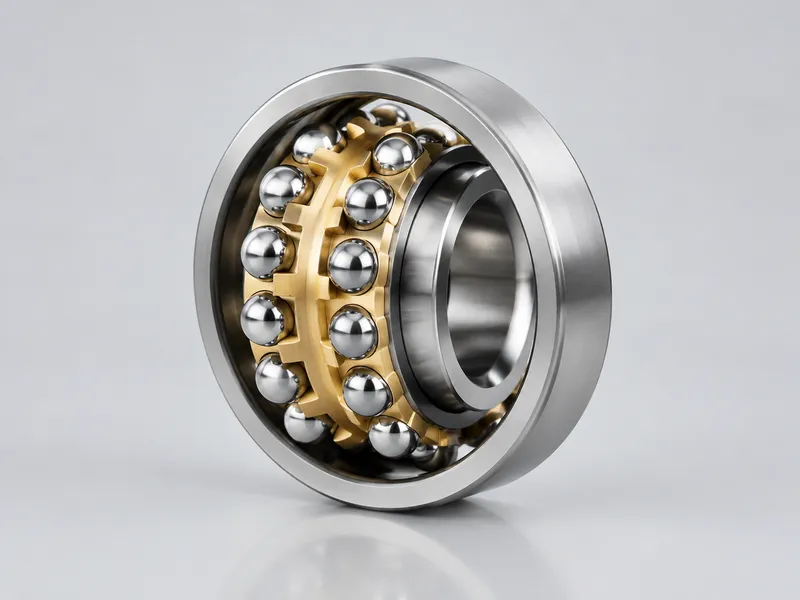
Self-aligning ball bearing 1211, open type, boundary dimensions 55 mm × 100 mm × 21 mm. Specifications below are model-bound published values; the source class is identified for each parameter. Send your application details through the RFQ for a confirmed quotation.
Last updated: 2026-11
Specifications
| Specification | Value | Parameter class | Source publisher |
|---|---|---|---|
| Bore diameter (d) | 55 mm | Model designation & boundary dimension | jtekt.co.jpManufacturer-published specification |
| Outside diameter (D) | 100 mm | Model designation & boundary dimension | jtekt.co.jpManufacturer-published specification |
| Width (B) | 21 mm | Model designation & boundary dimension | jtekt.co.jpManufacturer-published specification |
| Minimum chamfer (r min.) | 1.5 mm | Model designation & boundary dimension | jtekt.co.jpManufacturer-published specification |
| Basic dynamic load rating (Cr) | 33.5 kN Basic dynamic load rating is a catalog reference used in bearing-life calculations; confirm equivalent load, speed, reliability and required service life for the application. | Manufacturer catalog reference — not a supply guarantee | jtekt.co.jpManufacturer-published specification |
| Basic static load rating (C0r) | 10 kN Basic static load rating is a catalog reference; verify equivalent static load and the required static safety factor for the application. | Manufacturer catalog reference — not a supply guarantee | jtekt.co.jpManufacturer-published specification |
| Fatigue load limit (Cu) | 0.63 kN Fatigue load limit is a catalog reference, not a standalone allowable-load or service-life guarantee; verify application duty and lubrication conditions. | Manufacturer catalog reference — not a supply guarantee | jtekt.co.jpManufacturer-published specification |
| Limiting speed, grease lubrication | 5800 min-1 Catalog limiting speed for grease lubrication, not an application operating recommendation. Confirm lubricant, temperature, load, sealing and duty conditions before selection. | Manufacturer catalog reference — not a supply guarantee | jtekt.co.jpManufacturer-published specification |
| Limiting speed, oil lubrication | 7100 min-1 Catalog limiting speed for oil lubrication, not an application operating recommendation. Confirm lubricant, temperature, load, sealing and duty conditions before selection. | Manufacturer catalog reference — not a supply guarantee | jtekt.co.jpManufacturer-published specification |
| Shaft abutment diameter (da min.) | 63 mm | Model designation & boundary dimension | jtekt.co.jpManufacturer-published specification |
| Housing abutment diameter (Da max.) | 92 mm | Model designation & boundary dimension | jtekt.co.jpManufacturer-published specification |
| Fillet radius (r max.) | 1.5 mm | Model designation & boundary dimension | jtekt.co.jpManufacturer-published specification |
| Reference mass | 0.705 kg | Manufacturer catalog reference — not a supply guarantee | jtekt.co.jpManufacturer-published specification |
Parameter classes: Model designation & boundary dimension — what identifies the model (boundary dimensions follow the designation). Manufacturer catalog reference — the named manufacturer's published catalog data for this designation; it is not a guarantee that every unit we supply reaches these exact figures. Industry reference — a third-party or industry-published value; it is not specific to the named manufacturer and is not a supply guarantee. Supplier-confirmed — a value we have confirmed for our own supply. Order-confirmed — the value fixed in a specific order. None of the values on this page are supplier-confirmed yet; supply-specific figures (tolerance class, clearance, seal variant availability, lead time) are confirmed with your quotation.
The source publisher shown on each row identifies where that parameter was published; it is not necessarily the manufacturer supplying your order. Manufacturer-published specifications are linked where the source is approved for public linking. Industry-reference publishers are shown as text.
All values above are model-bound catalog values traceable to a collected source. Fields without collected evidence are not published; ask with your inquiry and we confirm them at quotation.
Manufacturer / model attribution: Koyo / JTEKT — 1211 (open type). This is the manufacturer named by the model-evidence record; it does not establish that every item supplied for an inquiry comes from this manufacturer. The actual manufacturer, original model and supplying source are confirmed in the quotation.
Source per specification field
| Specification | Source |
|---|---|
| Bore diameter (d) | jtekt.co.jp — manufacturer-published specification |
| Outside diameter (D) | jtekt.co.jp — manufacturer-published specification |
| Width (B) | jtekt.co.jp — manufacturer-published specification |
| Minimum chamfer (r min.) | jtekt.co.jp — manufacturer-published specification |
| Basic dynamic load rating (Cr) | jtekt.co.jp — manufacturer-published specification |
| Basic static load rating (C0r) | jtekt.co.jp — manufacturer-published specification |
| Fatigue load limit (Cu) | jtekt.co.jp — manufacturer-published specification |
| Limiting speed, grease lubrication | jtekt.co.jp — manufacturer-published specification |
| Limiting speed, oil lubrication | jtekt.co.jp — manufacturer-published specification |
| Shaft abutment diameter (da min.) | jtekt.co.jp — manufacturer-published specification |
| Housing abutment diameter (Da max.) | jtekt.co.jp — manufacturer-published specification |
| Fillet radius (r max.) | jtekt.co.jp — manufacturer-published specification |
| Reference mass | jtekt.co.jp — manufacturer-published specification |
Applications and selection notes
Self-aligning ball bearings carry radial load with a limited axial component in both directions and tolerate angular misalignment between shaft and housing. The spherical outer raceway lets the inner ring and balls swivel, which is why this type is used on long shafts, fan rotors, textile and conveying machinery — anywhere deflection or mounting tolerances would overload a rigid deep groove bearing.
How to read the specification table
Do not treat “self-aligning” as a universal 4–7° installation allowance. Manufacturer guidance is not one common rating: NSK gives approximately 0.07–0.12 rad (about 4–7°) for dynamic misalignment under normal loads; NTN gives a general normal-load alignment angle of 1/15 (about 3.8° when interpreted as tan θ); SKF publishes series-specific guideline values of 2.5–3° for open 12/13/22/23-series executions, but only 1.5° for its sealed 22 E-2RS1 and 23 E-2RS1 executions. These values describe different scopes and must not be averaged or transferred between brands.
The useful selection rule is to start with the exact manufacturer, series and execution, then use the lowest applicable limit imposed by the bearing and its surrounding structure. In SKF’s own table, the sealed 22 E-2RS1 / 23 E-2RS1 variants have only 1.5° permissible misalignment versus 2.5° for open 22(E) and 3° for open 23(E); the sealed version therefore cannot inherit the open bearing’s angular allowance. SKF explicitly says the table values are guidelines for normal operating conditions and that adjacent components (including external seals) may prevent full use. NSK likewise warns that surrounding structure can limit its stated range.
For RFQ and installation approval, state whether the misalignment is static or dynamic, its maximum magnitude and direction over a shaft revolution, the bearing maker and full designation, series, open/sealed execution, radial load as a proportion of the maker’s reference load, operating clearance after fit and temperature, shaft/housing geometry, and nearby seals or shoulders. Ask the manufacturer to confirm the permissible angle for that exact execution and load case. Do not approve a substitute solely because its catalogue says “self-aligning” or quotes a larger generic angle.
If the required angle exceeds the exact bearing/structure limit, reduce shaft deflection or correct the housing/seat alignment, or evaluate a different bearing arrangement (including spherical roller bearings) against load, speed and life. A self-aligning ball bearing has limited axial load capacity; its angular accommodation does not make it a heavy-thrust substitute.
Related engineering knowledge
Background reading that supports the selection decision on this page — failure modes, seal trade-offs and lubrication behavior. These articles explain the engineering; the specifications and supply commitments live on this page and in the quotation.
1211 — buying questions
What does the designation 1211 mean?
1211 is a standard boundary-dimension designation: the dimension series fixes the outside diameter and width proportions, and the bore code fixes the bore diameter — 55 mm for this bearing. Two bearings carrying the same designation from conforming manufacturers are dimensionally interchangeable; execution (seals, clearance class, cage) is the part that can differ, so state the execution you need when you request a quotation.
Are the catalog load rating and speed of 1211 enough for my application?
The table lists Basic dynamic load rating (Cr) = 33.5 kN and grease-lubricated limit 5800 min-1 and oil-lubricated limit 7100 min-1. The load rating is the starting point of a life calculation, and each speed is a catalog limit for the manufacturer’s execution, not an application operating recommendation. Seals, fits, temperature and lubrication all affect the usable speed in a real assembly. Both lubricant-specific limits are listed; compare each only under its stated lubricant and manufacturer execution. Send the application conditions with your inquiry and we confirm suitability before quoting; do not size from the catalog speed alone.
What information do you need to quote 1211?
Four things, in one message: the designation (and execution — seals, clearance class, precision class, if not standard), the quantity, the destination country, and any documents you require. Application conditions such as speed, load direction and temperature are welcome and let us verify the execution instead of assuming it. Quotation, lead time and the exact document set come back in writing.
Ordering & documentation
Documents
The documents available for 1211 depend on the actual supplying source and order. State any required export, origin, material or inspection documents in your inquiry; the available document set is confirmed in writing with the quotation.
Quotation
To quote 1211, send: the designation and required execution, quantity, destination country, and any required documents. Adding the application conditions (speed, load direction, temperature, fit) lets us confirm the execution and clearance class instead of quoting blind.
Sample & supply
If you need an evaluation sample of 1211, state the required quantity and timing. Sample feasibility, source, price and dispatch timing are confirmed in the quotation; sample availability is not assumed from the standard designation alone.
Lead time for this designation and quantity is confirmed in the quotation against the actual supplying source and availability. Any applicable certificates and quality documents are confirmed for the actual supplying source and product; available documents are stated in the quotation.
Storage & shipping
Store bearings flat in their original, unopened packaging in a dry indoor area away from temperature swings. Confirm the actual preservation method, packaging, marking and transport protection for the supplying source and order before shipment. Do not rotate a bearing through its rolling elements during handling or mounting.