Cross reference · 7200 series · angular contact
7200 Series Angular Contact Ball Bearing Cross Reference
The 7200 series is the light single-row line of the angular contact dimension plan: the same bores as the medium 7300 series in a narrower ring, for spindles and arrangements where axial loads, reversing loads or rigidity rule out a deep groove bearing. Each row below is one base designation with its published boundary dimensions and load rating, plus the 7300-series bearings that share the same bore. Every value is the same model-bound catalog figure as on the linked page — this table adds none. Executions we have not published with evidence are marked for confirmation at quotation, not guessed.
Last updated: 2026-11
7200 series executions — open B, paired, sealed
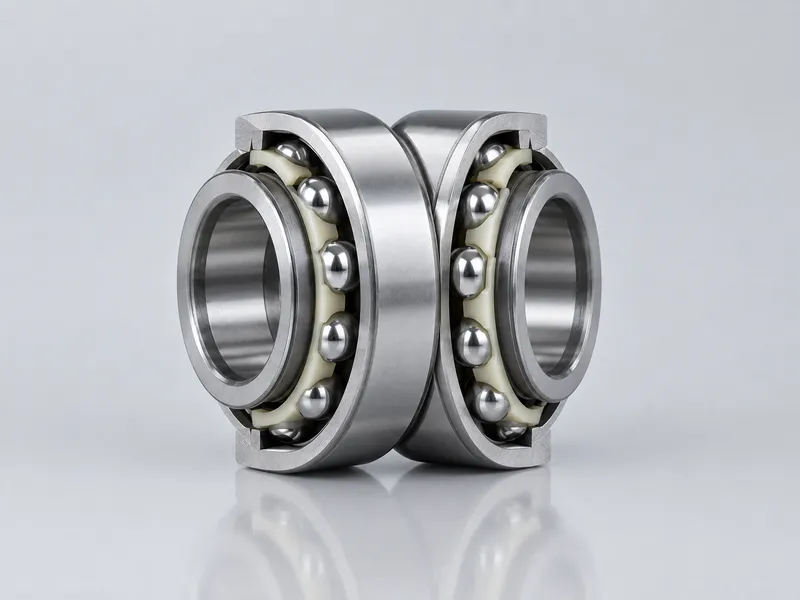
7204B is the open execution with the B contact angle, as marked in our collected manufacturer catalog; it carries one-directional axial capacity and is usually installed in pairs (DB back-to-back, DF face-to-face or DT tandem) where loads act both ways. Our published evidence for the 7200 series currently covers the open B execution only, so the paired and sealed cells below are shown as Confirm at quotation: we supply those executions on request after confirming the details, we do not quote them from this table. The base designations 7204B through 7220B are all present in our collected manufacturer catalog and all published below; smaller and larger bores of the series (7200–7203, 7221B and up) are not published yet — send them to us and we confirm availability at quotation.
| Base designation | Bore d (mm) | OD D (mm) | Width B (mm) | Cr (open) | Open (B) | Paired (DB/DF/DT) | Sealed / shielded | RFQ |
|---|---|---|---|---|---|---|---|---|
| 7204B | 20 | 47 | 14 | 17.6 kN | 7204B | Confirm at quotation | Confirm at quotation | Request quote |
| 7205B | 25 | 52 | 15 | 18.4 kN | 7205B | Confirm at quotation | Confirm at quotation | Request quote |
| 7206B | 30 | 62 | 16 | 25.6 kN | 7206B | Confirm at quotation | Confirm at quotation | Request quote |
| 7207B | 35 | 72 | 17 | 33.8 kN | 7207B | Confirm at quotation | Confirm at quotation | Request quote |
| 7208B | 40 | 80 | 18 | 40.2 kN | 7208B | Confirm at quotation | Confirm at quotation | Request quote |
| 7209B | 45 | 85 | 19 | 45.1 kN | 7209B | Confirm at quotation | Confirm at quotation | Request quote |
| 7210B | 50 | 90 | 20 | 46.7 kN | 7210B | Confirm at quotation | Confirm at quotation | Request quote |
| 7211B | 55 | 100 | 21 | 57.7 kN | 7211B | Confirm at quotation | Confirm at quotation | Request quote |
| 7212B | 60 | 110 | 22 | 69.9 kN | 7212B | Confirm at quotation | Confirm at quotation | Request quote |
| 7213B | 65 | 120 | 23 | 79.5 kN | 7213B | Confirm at quotation | Confirm at quotation | Request quote |
| 7214B | 70 | 125 | 24 | 86.4 kN | 7214B | Confirm at quotation | Confirm at quotation | Request quote |
| 7215B | 75 | 130 | 25 | 93.6 kN | 7215B | Confirm at quotation | Confirm at quotation | Request quote |
| 7216B | 80 | 140 | 26 | 101 kN | 7216B | Confirm at quotation | Confirm at quotation | Request quote |
| 7217B | 85 | 150 | 28 | 116 kN | 7217B | Confirm at quotation | Confirm at quotation | Request quote |
| 7218B | 90 | 160 | 30 | 133 kN | 7218B | Confirm at quotation | Confirm at quotation | Request quote |
| 7219B | 95 | 170 | 32 | 145 kN | 7219B | Confirm at quotation | Confirm at quotation | Request quote |
| 7220B | 100 | 180 | 34 | 163 kN | 7220B | Confirm at quotation | Confirm at quotation | Request quote |
Same-bore companions in the 7300 series
The light 7200 series and the medium 7300 series share their bore numbers: for each 72xx designation, the 73xx companions below are published pages whose bore dimension was checked equal — a 73xx companion fits the same shaft in a wider and taller ring with a higher load rating, trading space for capacity. Same bore is still only the first check: contact angle, clearance class, cage design and speed capability can differ between series and brands, so confirm the substitution against your application or send us the original designation. Deep-groove bearings sharing these bores are listed on the deep groove cross reference pages, not here — a contact bearing and a deep groove bearing are not exchange pairs even at equal boundary dimensions.
| 7200-series designation | Bore d (mm) | Published same-bore 73xx companions | Companion boundary (d × D × B, mm) |
|---|---|---|---|
| 7204B | 20 | 7304B | 7304B: 20 × 52 × 15 |
| 7205B | 25 | 7305B | 7305B: 25 × 62 × 17 |
| 7206B | 30 | 7306B | 7306B: 30 × 72 × 19 |
| 7207B | 35 | 7307B | 7307B: 35 × 80 × 21 |
| 7208B | 40 | 7308B | 7308B: 40 × 90 × 23 |
| 7209B | 45 | 7309B | 7309B: 45 × 100 × 25 |
| 7210B | 50 | 7310B | 7310B: 50 × 110 × 27 |
| 7211B | 55 | 7311B | 7311B: 55 × 120 × 29 |
| 7212B | 60 | 7312B | 7312B: 60 × 130 × 31 |
| 7213B | 65 | 7313B | 7313B: 65 × 140 × 33 |
| 7214B | 70 | 7314B | 7314B: 70 × 150 × 35 |
| 7215B | 75 | 7315B | 7315B: 75 × 160 × 37 |
| 7216B | 80 | 7316B | 7316B: 80 × 170 × 39 |
| 7217B | 85 | 7317B | 7317B: 85 × 180 × 41 |
| 7218B | 90 | 7318B | 7318B: 90 × 190 × 43 |
| 7219B | 95 | 7319B | 7319B: 95 × 200 × 45 |
| 7220B | 100 | 7320B | 7320B: 100 × 215 × 47 |
Where the 7200 series fits
Angular contact ball bearings carry combined loads: the contact angle between the raceway and the ball axis lets the ring support a substantial axial component in one direction, which a same-bore deep groove bearing accepts only in limited measure. The B suffix on every designation above marks the contact angle class of our collected catalog's execution. What the designation does not settle: internal clearance, preload, cage material and matched-pair grinding can all differ between brands and executions — so treat an equivalent as a candidate, not a confirmed swap. The checking sequence is described in how to find a replacement for an existing bearing model.
This page covers the 7200 (light) series only. The medium 7300 series is on its own 7300 series cross reference page, and the deep groove series (60xx/62xx/63xx/68xx/69xx) on the main deep groove ball bearing cross reference hub.
Failure modes in service — 7200 series
An angular contact bearing fails differently from a deep groove bearing of the same bore: its raceway offset carries axial load through a single line of contact, which makes preload, thrust direction and mounting arrangement the decisive variables — not the load rating. The published 7200-series pages are open, single (B-contact-angle) executions; the failure modes below are the ones that end such bearings early, in the order real installations produce them.
Preload: too little skids, too much cooks
The 72xx lives on a narrow preload window, and both edges are documented failure modes. Too little: correct preload is what keeps continuous contact at the raceway offset — it "prevents rolling elements from skidding, which eliminates smearing damage and extends bearing life" (angular contact selection guide); below the minimum load, the balls slide, smear and wear the raceways, and the practitioner's remedy is selection, not lubrication (minimum-load discussion). Too much: excessive preload "generates unnecessary heat, increases friction losses, and accelerates wear", and the window tightens further under dynamic loading and thermal expansion (preload design analysis).
High-speed duty compresses the window from both ends: rapid acceleration, combined loads and thermal growth make improper load matching show up as skidding, vibration and reduced fatigue life, with correct preload and load distribution named as the critical variables in spindle-type applications (high-speed machinery bearing guide). State the preload arrangement you intend when requesting a 72xx quotation — we confirm clearance class and execution against it.
One-directional thrust and the missing pair
A single angular contact bearing carries axial load in one direction only; under bidirectional thrust it must be mounted in back-to-back or face-to-face pairs (angular contact selection guide). The classic 72xx failure is not material but arrangement: a single B-contact-angle bearing asked to locate a shaft that can move axially the other way — under coupling pull, helical gear thrust reversal, thermal expansion of the driven machine — unloads the contact line, lets the balls skid, and damages both raceways in a pattern no amount of lubrication repairs.
The standard arrangements each buy something specific: back-to-back increases rigidity, face-to-face allows flexibility for thermal expansion, tandem increases axial capacity in one direction (pairing arrangements guide) — with back-to-back (DB) giving the highest moment rigidity, face-to-face (DF) accommodating thermal growth at lower moment rigidity, and tandem (DT) maximum one-direction capacity (matched-set arrangements). We supply matched pairs on request; the duplex execution of these designations is confirmed at quotation, not assumed from this table.
Cage fracture in precision positions
Cage fracture in precision bearings is "among the most dangerous failure modes because it can cause sudden, complete bearing seizure rather than gradual degradation", commonly linked to excessive speed beyond the limiting speed rating, inadequate lubrication causing rolling-element skidding and cage impact loading, or incorrect handling during installation — stamped steel cages being particularly sensitive to impact (precision bearing component guide). Once the cage goes, the balls bunch and skid and the bearing is finished; the root cause lives in the duty history, not the debris.
Rapid speed cycling adds the inertial route: equipment whose RPM swings up and down subjects the cage to high inertial loads, which can fatigue it to functional end-of-life even with no raceway spall — the documented fix being a more robust cage design (bearing speed-limit documentation). The limiting speeds published on each linked 72xx page are the ceiling that keeps the cage out of both regimes; running above them belongs to a precision-engineering conversation, not a tolerance on this one.
Misalignment and edge loading
The contact-line geometry that gives an angular contact bearing its axial capacity makes it unforgiving of tilt: when inner and outer rings are not concentric, or shaft and housing axes are not parallel, the load concentrates on one edge of the raceway, with asymmetric wear patterns, elevated temperature and a 1×/2× vibration signature as the documented signs (bearing failure causes analysis). Calculated capacity assumes misalignment not exceeding about 0.0005 rad; more delivers less than the calculated life (bearing capacity documentation).
For a 72xx position the check list is specific: housing bore squareness to the shoulder, shaft shoulder runout, and the thermal case — alignment verified cold can be lost at operating temperature as frame and shaft grow differently (motor bearing field guide). Edge loading from a tilted outer ring is the quiet companion of every loose housing bolt, so bolt torque belongs in the same inspection.
Electrical erosion in driven spindles
High-speed 72xx positions increasingly sit on variable-frequency drives, and the documented arithmetic is stark: bearings account for roughly 51% of electric motor failures, lubrication breakdown for about 80% of those, and electrical fluting — stray shaft current arcing through the thin oil film and micro-cratering the raceway — for a severe share of the rest (motor bearing reliability data). Field triage reads it directly: "electrical fluting leaves a distinct washboard-style pattern that changes the whole troubleshooting path" (motor bearing damage-pattern guide).
The countermeasures are electrical and specified at selection: an insulated or ceramic-hybrid bearing on the affected end, a shaft grounding ring, correct earthing — with the grounding ring kept in the package because insulating both ends can shift discharge into the coupled machine. A grease change prevents none of it. State the drive duty in the inquiry and we confirm the execution accordingly.
The family-level trade against the deep groove plan — same envelope, different contact — is on our 7204B vs 6204 comparison; the damage atlas behind this section is in the failure-modes overview. Each designation above links to its model-bound page for dimensions, ratings and speed ceilings.